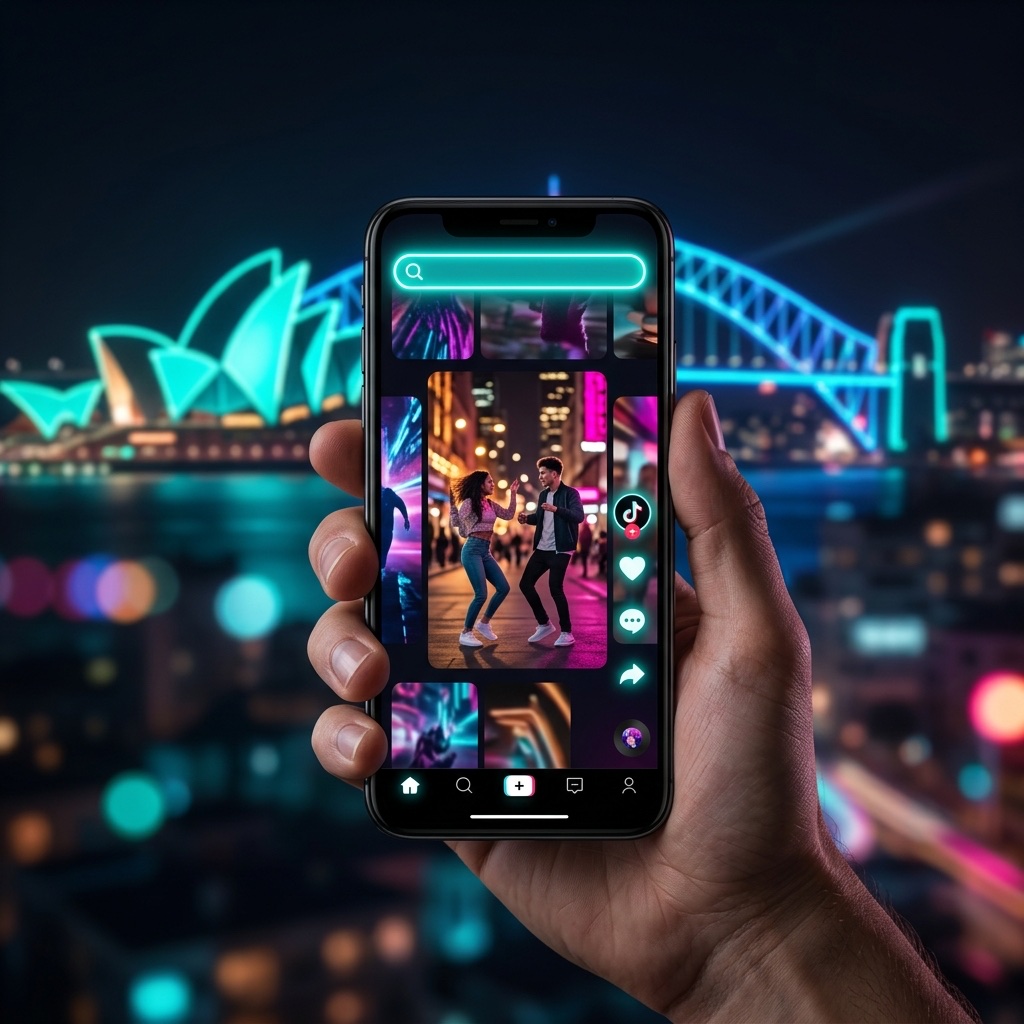
When a 22-year-old in Bondi wants to find a good barber, they do not Google "barber Bondi". They open TikTok, type "barber Bondi" into the in-app search bar, and scroll through 30-second videos of haircuts being done in real shops by real barbers. By the time they walk in, they have already seen the chair, the music, the conversation style, and the result. Google never enters the equation.
This is not a fringe behaviour any more. Google's own leaked internal research, surfaced in 2024 and confirmed by independent surveys since, found that nearly 40% of users under 25 open TikTok or Instagram first when searching for local businesses. The numbers have only climbed in 2026. For a generation that will dominate consumer spending within five years, search no longer means Google.
Why Social Search Wins for Local
The reason is not just generational preference. Social search delivers something Google structurally cannot: proof, in motion, in 30 seconds. A static Google review of a hairdresser is "great cut, friendly service, 5 stars". A TikTok video shows the actual cut, the actual chair, the actual vibe. One requires you to trust the reviewer. The other shows you the answer.
For categories where the experience itself is the product — food, beauty, fitness, hospitality, retail — that visual proof is wildly more persuasive than text. A 14-second clip of a sourdough being cut open at a Surry Hills bakery converts a Gen Z viewer in a way that a 4.8-star Google rating simply cannot.
The Trust Math, Restated
A 2025 study of Australian Gen Z consumers found that video reviews and behind-the-scenes content increased local-business trust by 2-3x compared to written reviews of the same length. The difference was even larger for hospitality, beauty, and fitness — categories where "the vibe" is half the purchase decision.
How TikTok Search Actually Works
TikTok's search algorithm is not a copy of Google's. It optimises for three things: recency, engagement velocity, and discoverability signals like captions, hashtags, and on-screen text. A video posted yesterday with strong watch-time can outrank a video posted six months ago with ten times the followers.
Crucially, TikTok treats captions and on-screen text as keywords. If your video opens with the words "best Thai restaurant in Newtown" written across the screen, that video becomes discoverable for that exact search — regardless of your follower count. This is the single most underused tactic in Australian local-business marketing right now.
What a Working Sydney Strategy Looks Like
The Sydney businesses winning on TikTok search have stopped treating it as a "social media platform" and started treating it as a search engine that happens to use video. Their playbook is consistent.
One video per week, minimum. Recency matters. Sporadic posting kills algorithmic momentum. Two to three short videos per week is the floor — even if they are 15-second clips shot on a phone in the shop.
Searchable captions. Every video opens with on-screen text containing the exact phrase a customer would type. "Best wood-fired pizza Marrickville". "Eyebrow tinting Bondi Junction". "Mechanic Parramatta open Saturday". These are searches, and the captions get indexed.
Location tags + suburb hashtags. #sydneyfood #parramatta #northshore — niche local tags outperform broad national ones for discovery. Tag every video with the suburb, not just the city.
Show, do not tell. Videos that demonstrate the result — the haircut, the dish being plated, the room being styled — outperform talking-head explainers by a wide margin. The platform rewards content that shows what the business actually does.
Native, not recycled. Reposted Instagram Reels with the watermark visible get suppressed by TikTok's algorithm. Shoot for TikTok, post on TikTok, then cross-post the clean version to Reels.
The 90-Day Test
Local businesses that commit to two video posts per week for 90 days — searchable captions, suburb hashtags, native-shot — typically see meaningful discovery traffic by week six and a measurable lift in foot traffic or bookings by week twelve. The businesses that quit at week three see nothing, because TikTok's algorithm has not yet figured out who their content is for.
The Instagram Question
Instagram is the other social search engine that Sydney businesses cannot ignore. Reels behave similarly to TikTok in many ways, and Instagram's in-app search now indexes Reels captions, location tags, and even spoken audio. The good news: the same content strategy works on both platforms. The bad news: Instagram's organic reach has collapsed in 2026 (see our separate article on this in our May issue), making TikTok the higher-yield platform for cold discovery right now.
The Bottom Line
If you run a local Sydney business and you have spent the last decade optimising your Google presence, that work is not wasted — but it is no longer enough. The next generation of customers is searching somewhere your business is invisible. The fix is not complicated, but it does require commitment: a real, consistent presence on TikTok, treated as a search engine rather than a hobby.
The Yellow Pages did not die because the phone book got worse. It died because the search behaviour moved. Google is not the Yellow Pages, but the parallel is exact. The businesses that figure this out in 2026 will own a discovery channel that their competitors do not even know exists yet.