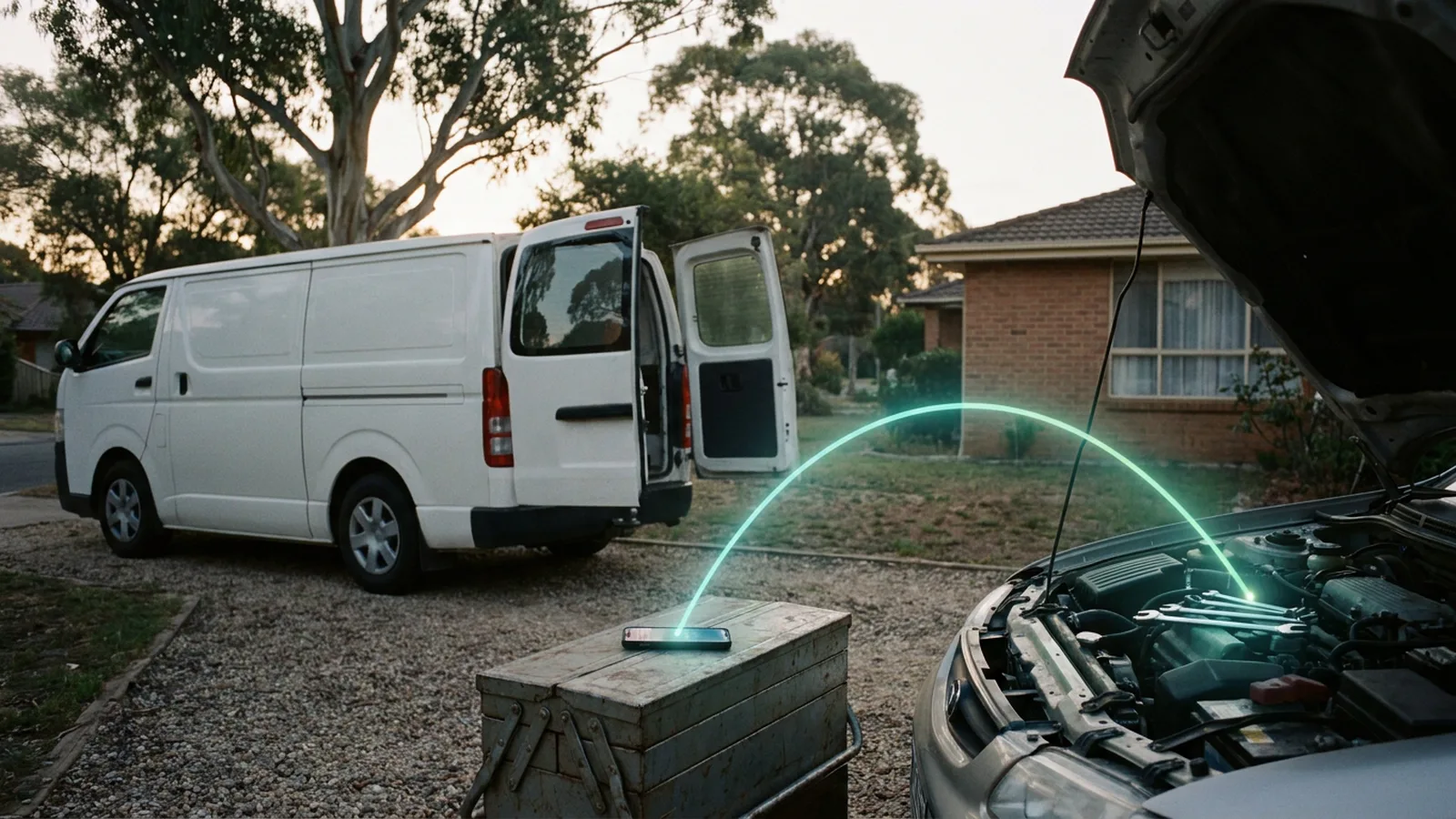
Pro Tune Mobile Mechanic's Google Ads campaign went live on 13 July 2026. In its first 50 days it took 4,382 impressions, 253 clicks at a 5.77% click-through rate, and 26 tracked enquiries: 21 booking forms and 5 calls placed straight from the ad. Those are the enquiries Google Ads could see. Simon also took calls directly that tracking cannot attribute, which puts the real total at around 30.
Pro Tune is a mobile mechanic working across Sydney, and a K&G client whose website and campaign we built. Every figure below comes out of the Google Ads API for their account, covering 13 July to 31 August 2026. We are publishing the performance numbers with their knowledge and keeping their budget private, because what it costs them is their business and what it produced is the useful part.
What are the headline numbers?
Over 50 days the campaign was shown 4,382 times and clicked 253 times, a click-through rate of 5.77%. It recorded 26 tracked conversions: 21 completed booking forms and 5 phone calls placed directly from the ad itself. A further 15 taps on the phone number on the website were recorded as a secondary action.
The month-on-month split matters more than the total, because the first period was a partial month. From 13 to 31 July the campaign took 1,151 impressions, 65 clicks and 10 conversions. Through August it took 3,231 impressions, 188 clicks and 16 conversions, with the click-through rate holding steady at 5.82%.
That steadiness is the thing to notice. Nearly tripling the impressions without the click-through rate dropping means the extra reach was not bought by widening into vaguer searches, which is the usual way a campaign grows its numbers while getting worse.
Is a 5.77% click-through rate any good?
We hold a new local search campaign to a 4% click-through gate in its first fortnight. Below that we assume the ads or the keywords are wrong and rebuild rather than wait. This one cleared the gate in week one and has stayed above it every week since.
A gate beats an industry benchmark because benchmarks are averages across wildly different businesses and tell you almost nothing about yours. A threshold set in advance forces a decision at a fixed date instead of letting a mediocre campaign run on hope.
Click-through rate is also the earliest honest signal you get. Conversions take weeks to accumulate into anything readable. Whether people click your ad when they see it is answerable in days.
How many clicks turn into enquiries?
26 tracked conversions from 253 clicks is a conversion rate of 10.3%. Roughly one in ten people who clicked the ad went on to book or call.
Two things sit behind that number. The landing page is the site we built for the business, so the ad and the page make the same promise in the same words. And the conversion actions count what actually matters to a mobile mechanic: a submitted booking, and a phone call. Not a page view, not a scroll, not a bounce rate.
The 15 additional taps on the website phone number are worth a word. They are recorded separately and deliberately not counted in the 26, because a tap is not proof a conversation happened. Counting them in the headline would inflate the result by nearly 60%, which is exactly the kind of quiet flattery that makes ad reporting untrustworthy.
Count the thing, not the proxy
Most disappointing ad reports are honest arithmetic on the wrong measurement. Clicks, impressions, reach and engagement all go up when you spend more, and none of them are enquiries. Decide before launch what a real enquiry looks like in your business, set that up as the conversion, and let every other number stay a diagnostic rather than a result.
Which parts of the campaign did the work?
The campaign runs six ad groups. They did not contribute equally, and the pattern is instructive.
| Ad group | Impressions | Clicks | CTR | Conversions |
|---|---|---|---|---|
| Core service terms | 2,876 | 149 | 5.2% | 14 |
| Servicing and inspections | 616 | 44 | 7.1% | 5 |
| Emergency and 24/7 | 392 | 25 | 6.4% | 2 |
| Named suburbs | 168 | 16 | 9.5% | 3 |
| Parts and repairs | 268 | 12 | 4.5% | 0 |
| Brand defence | 62 | 7 | 11.3% | 2 |
The core terms carried the volume and just over half the conversions. But the highest click-through rates came from the two smallest groups: the ones bidding on named suburbs, and the group defending the business's own name.
What did the winning keywords have in common?
Specificity. The pattern is almost linear.
The best performer was an exact-match "near me" phrase: 160 impressions, 25 clicks and 4 conversions at a click-through rate of 15.6%. A specific inspection service returned 10.1% across 276 impressions. Meanwhile a broad phrase pairing the trade with the city name took 895 impressions, the most of any keyword, and converted them at 2.7% into 24 clicks and 3 conversions. Another broad "near me" variant took 672 impressions, 20 clicks and no conversions at all.
So the widest keyword produced the most impressions, a below-average click-through rate, and modest results. The narrow ones produced a fraction of the impressions and most of the efficiency. If you have a small budget, this is the whole argument for starting narrow: you cannot outbid a large competitor on the obvious term, and you do not need to.
Where do the enquiries actually come from?
Mobile, which will surprise nobody who has ever needed a mechanic. 3,669 of the 4,382 impressions and 200 of the 253 clicks were on a phone.
The more interesting figure is what happens after the click. Mobile produced 18 conversions from 200 clicks, about 9%. Desktop produced 8 conversions from 49 clicks, about 16%. Desktop is a fifth of the traffic and converts at nearly twice the rate.
The desktop sample is small and we will not over-read it. But it fits a pattern worth testing on your own account: the phone captures the urgent job while someone stands next to a car that will not start, and the desk captures the planned service or inspection someone books in their own time. Reporting only the total hides that they behave differently.
What is the campaign not doing yet?
Showing up. Its search impression share is 11.7%, which means that for the searches it is eligible for, the ad appeared roughly one time in eight.
That is the single largest piece of headroom in the account and it is a budget question rather than a quality one. The campaign is not being held back by weak ads or bad targeting; it is running out of money before the day runs out of searches. It also means the results above were produced by a campaign that was invisible on seven out of eight opportunities, which is a useful thing to know before deciding whether the approach is working.
What would we tell another trade business?
Start narrower than feels comfortable. The broad category term will take most of your impressions and disappoint you.
Set the conversion up properly before launch, on booked jobs and answered calls rather than clicks, and refuse to count taps and views alongside them. Send the traffic to a page that says what the ad said. Write down a click-through gate and a stopping rule in advance and hold yourself to them, because the alternative is renegotiating with yourself every month. And read impression share early: a campaign appearing one time in eight is not a verdict on the strategy.
What this does not prove
One account, one trade, one city, 50 days. 26 conversions is enough to see a direction and not enough to be confident about small differences between ad groups or devices. We have not published what the campaign costs, so nothing here tells you the return on investment, which is the number that ultimately decides everything.
What it does show is what a small, tightly built local search campaign produces in seven weeks when the counting is honest.
Sources: Google Ads API, Pro Tune Mobile Mechanic account, campaign performance 13 July to 31 August 2026, pulled 1 September 2026. Published with the client's knowledge; budget and spend withheld.
Related reading: Google Ads against SEO for a small business and marketing for tradies in Sydney.
Running ads and not sure whether they are working? Send us read-only access and we will tell you what the account actually says, including when the answer is to switch it off.