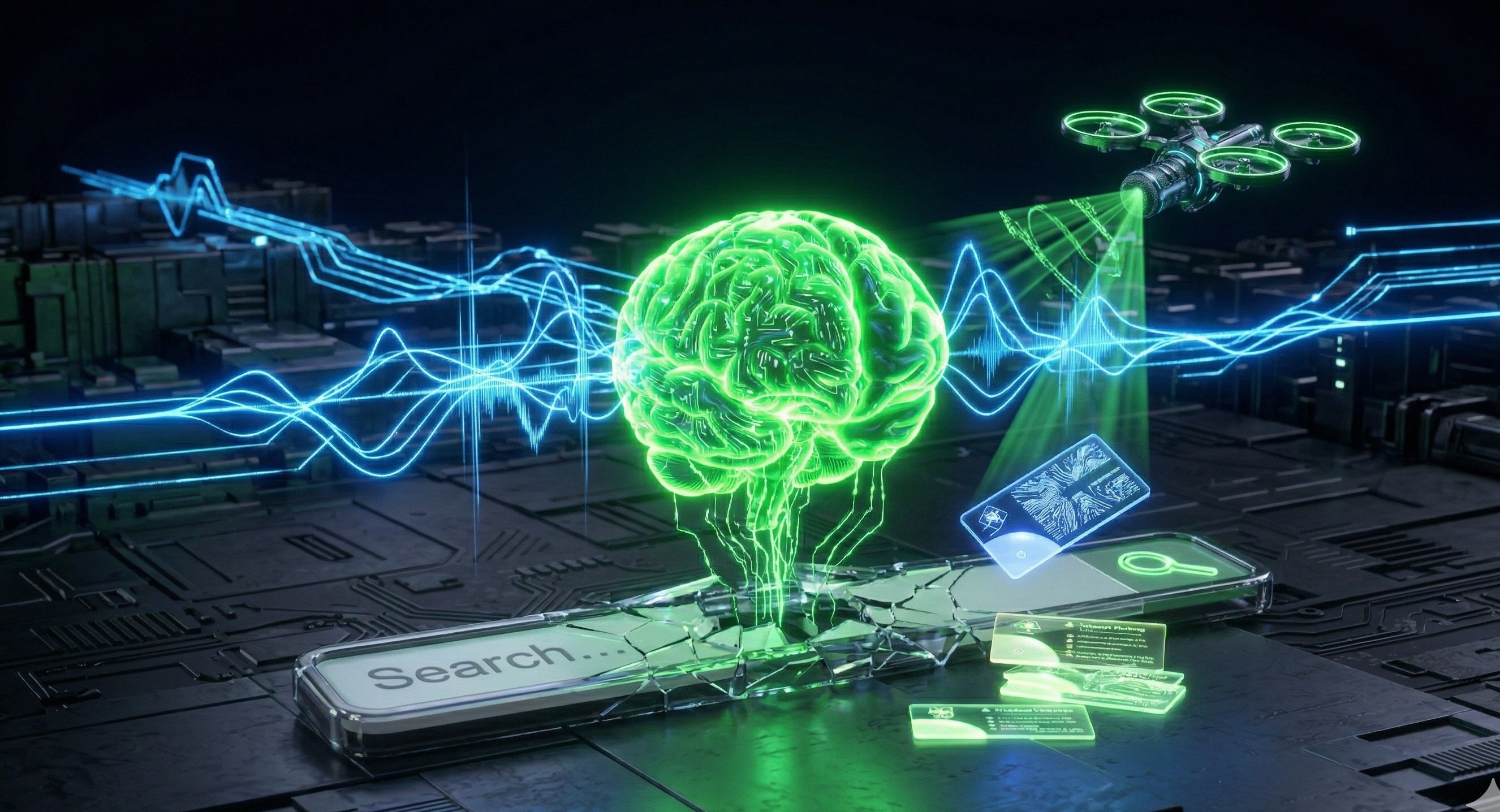
For twenty-five years, "just Google it" was the answer to every question. That era is ending. In late 2025, Google's global search market share dipped below 90% for the first time in over a decade. The erosion is not coming from Bing or Yahoo. It is coming from ChatGPT, Perplexity, TikTok, and a generation of consumers who never developed the habit of typing keywords into a search bar in the first place.
For Sydney businesses that have spent years optimising for Google rankings, this is not a minor tremor. It is a tectonic shift in how customers discover, evaluate, and choose the businesses they spend money with. And the agencies that understand what is happening are already rebuilding their strategies from the ground up.
Google Is Still Dominant. But the Cracks Are Real.
Let us be clear: Google is not dying. It still processes over 8.5 billion queries per day and remains the single largest source of commercial intent traffic on the internet. But dominance and invulnerability are different things, and the data points accumulating through 2025 and into 2026 tell a story that no serious marketer can ignore.
StatCounter data shows Google's search market share has fallen from 93% to below 90% in under eighteen months. That may sound like a small number until you do the maths: a 3-point drop in a market that processes billions of daily queries represents hundreds of millions of searches per day that are now happening somewhere else entirely.
More critically, the demographic breakdown reveals the real story. Among users aged 18 to 24, traditional search engine usage has dropped significantly. These users are not switching to a different search engine. They are abandoning the concept of a search engine altogether in favour of conversational AI tools and social platforms that deliver answers in fundamentally different ways.
The Numbers Behind the Shift
A 2025 Adobe study found that 40% of Gen Z prefer using TikTok over Google for local discovery searches like "best coffee near me" or "plumber in my area." Meanwhile, ChatGPT and Perplexity are capturing an increasing share of research-stage queries that previously drove organic search traffic. For businesses that rely on being found through Google, the pool of potential customers using that channel is shrinking every quarter.
AI Overviews Are Eating Organic Clicks
Even within Google itself, the rules have changed. Google's AI Overviews — the AI-generated summary boxes that now appear at the top of many search results pages — are fundamentally altering the economics of organic search.
Research from multiple SEO analytics firms including Ahrefs, SEMrush, and Rand Fishkin's SparkToro has converged on a troubling finding: queries that trigger AI Overviews see an average 25% reduction in click-through rates to organic results below the fold. For some categories, particularly informational queries, the drop is closer to 40%.
The mechanism is simple. When Google's AI Overview answers a user's question directly at the top of the page, there is no reason to click through to the website that provided the source information. The user gets their answer, Google keeps the engagement, and the business that created the content receives nothing — no visit, no lead, no conversion.
For Sydney businesses, this hits differently depending on industry. A restaurant searching for "best Italian Surry Hills" might still benefit from Google Maps integration. But a financial planner who ranked first for "how much super should I have at 40" is watching their organic traffic evaporate as Google's AI Overview answers the question directly. The traffic that used to flow to their blog post — and their lead capture form — now dead-ends in a grey box at the top of the SERP.
TikTok: The Search Engine Nobody Saw Coming
The most unexpected challenger to Google's search dominance is not another search engine at all. It is a short-form video platform that was originally built for lip-syncing and dance videos.
TikTok has evolved into a genuine discovery engine for an entire generation. When a 22-year-old in Bondi wants to find a good barber, they do not open Google and type "barber near me." They open TikTok and search "barber Bondi" or scroll through location-tagged content until they find a video that shows the actual haircut quality, the vibe of the shop, and real customer reactions.
The numbers are staggering. Google's own internal research, leaked in 2024, found that nearly 40% of young users go to TikTok or Instagram when looking for a place to eat, rather than Google Maps or Search. The behaviour has only accelerated since then.
For local Sydney businesses, this creates an entirely new competitive dynamic. The restaurant with 500 Google reviews but zero TikTok presence is invisible to a growing segment of the market. The tradie with a perfectly optimised Google Business Profile but no video content showing their work is losing jobs to competitors who post 30-second reels of their finished projects.
How TikTok Search Actually Works
TikTok's search algorithm prioritises recency, engagement rate, and hashtag relevance rather than traditional SEO signals like backlinks and domain authority. A single viral video from a Sydney cafe can generate more local awareness in 48 hours than six months of blog posts optimised for Google. Businesses that understand this are creating content specifically for TikTok's search behaviour — using location hashtags, trending audio, and searchable captions that mirror the queries their customers actually type.
Welcome to GEO: Generative Engine Optimization
If SEO was the practice of optimising content to rank in traditional search engines, GEO — Generative Engine Optimization — is the emerging discipline of optimising content to be cited, referenced, and recommended by AI systems.
When someone asks ChatGPT "What is the best digital marketing agency in Sydney?", the AI does not return a list of blue links. It synthesises information from across the web and provides a direct answer, sometimes naming specific businesses. The question every agency and business owner should be asking is: what determines whether your business gets mentioned in that answer?
Early research from Princeton and Georgia Tech into how large language models select and cite sources suggests several key factors:
- Authoritative, structured content — AI models preferentially cite content that is well-organised, uses clear headings, and makes definitive statements rather than vague hedging.
- Consistent entity information — businesses with consistent Name, Address, and Phone (NAP) data across multiple authoritative sources are more likely to be surfaced by AI.
- Third-party validation — mentions in news articles, industry publications, review sites, and directories carry significant weight. AI systems treat these as trust signals.
- Structured data markup — Schema.org markup, FAQ schemas, and proper metadata give AI systems clean, parseable information about your business.
- Freshness and depth — regularly updated, comprehensive content on specific topics signals topical authority that AI models reward.
GEO is not replacing SEO. It is adding a new layer on top of it. Businesses that ignore it will gradually become invisible not just on Google, but across the entire ecosystem of AI-powered discovery tools that are rapidly becoming mainstream.
How This Hits Sydney Businesses Differently
The impact of the AI search shift is not uniform across industries. Different business types in Sydney are experiencing this disruption in distinct ways.
Restaurants and hospitality are the most immediately affected. This sector relies heavily on discovery searches, and the migration to TikTok and Instagram for "where should I eat" queries is already well advanced. Sydney restaurants that are not creating short-form video content showcasing their food, atmosphere, and personality are ceding ground to competitors who are. Google Maps still matters, but it is no longer sufficient on its own.
Tradies and home services are seeing a slower but equally significant shift. While emergency searches ("plumber near me now") still happen predominantly on Google, research-stage queries ("how much does a bathroom reno cost in Sydney") are increasingly going to AI chatbots. Tradies whose websites provide detailed, authoritative answers to these questions are more likely to be cited by AI tools — and more likely to capture the lead when the homeowner eventually picks up the phone.
Professional services — accountants, lawyers, financial planners, medical practices — face the steepest challenge. Their existing SEO strategies typically rely on educational blog content that drives organic traffic. AI Overviews are decimating the click-through rates on exactly these types of informational queries. These businesses need to pivot toward content strategies that build brand recognition and AI-citability rather than relying purely on ranking for high-volume keywords.
The Multi-Channel Imperative
The era of "just rank on Google" as a complete marketing strategy is over. In 2026, a Sydney business serious about growth needs simultaneous presence across at least three discovery channels:
- Google Search and Maps — still the largest single source of high-intent local traffic. Google Business Profile optimisation, reviews, and local SEO remain essential.
- Social discovery platforms — TikTok, Instagram Reels, and YouTube Shorts for the under-35 demographic. Video content that shows rather than tells.
- AI-citeable content — authoritative, well-structured web content that AI systems can parse, trust, and reference when answering user queries about your industry or location.
This is not about doing three times the work. It is about creating content once and adapting it for each channel. A single customer case study can become a blog post (Google), a 60-second video (TikTok), and a structured data-rich page that AI systems reference (GEO). The businesses and agencies that build this kind of content multiplication workflow will dominate the next five years.
What the Best Agencies Are Already Doing
The sharpest digital marketing agencies in Sydney are not waiting to see how this plays out. They are already restructuring their service offerings around the new reality.
Agencies like The Level Up and Neyox have been vocal about integrating AI search optimisation into their core strategies. They are building structured data into every client website, creating content specifically designed for AI citation, and running multi-platform campaigns that treat Google as one channel among several rather than the only channel that matters.
The common thread among forward-thinking agencies is a shift from keyword-centric to entity-centric marketing. Instead of asking "what keywords should we rank for?", they are asking "how do we make this business the most authoritative, most referenced, most visible entity in its category across every platform where customers discover businesses?"
That is a fundamentally different question, and it leads to fundamentally different strategies: stronger brand presence, more consistent data across platforms, richer structured markup, more social proof, and content that answers questions authoritatively rather than just targeting search volume.
Practical Steps You Can Take This Week
Start with the fundamentals. Audit your NAP consistency across Google, Facebook, Instagram, Apple Maps, Yelp, and industry directories. Add structured data markup (LocalBusiness, FAQ, Review schemas) to your website. Create one short-form video that showcases your business and post it to TikTok and Instagram with location-relevant hashtags. Write one authoritative, comprehensive article that answers the most common question your customers ask. These four actions will put you ahead of 90% of Sydney businesses that have not started adapting to the AI search shift.
The Bottom Line
Google is not going away. But the days of Google being the only way customers find your business are already behind us. The businesses that thrive in 2026 and beyond will be the ones that build visibility across traditional search, social discovery, and AI-powered recommendation systems simultaneously.
The search bar is not dead yet. But for a growing share of the market, it is already irrelevant. The question is not whether your business needs to adapt. It is whether you will adapt before your competitors do.